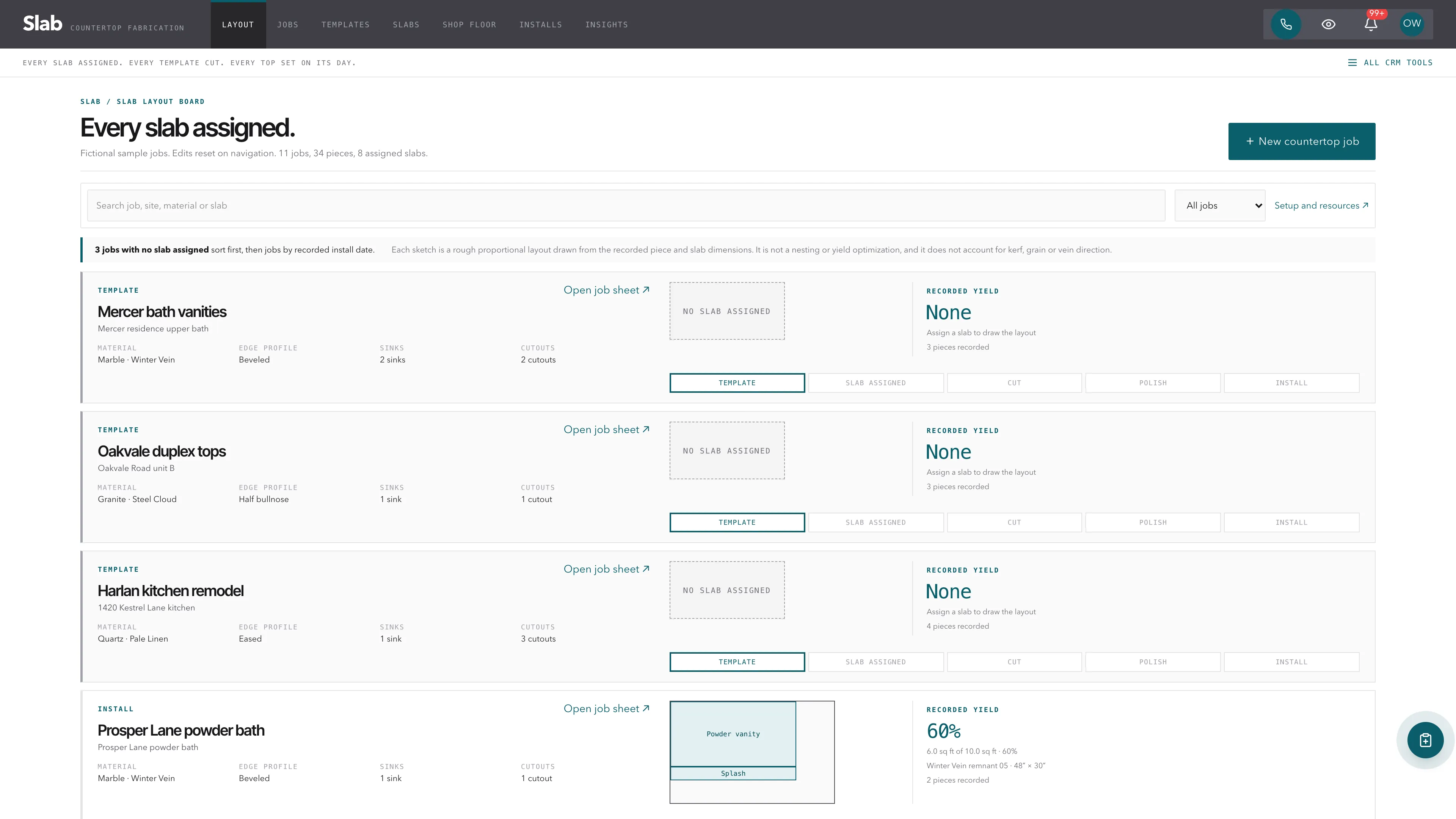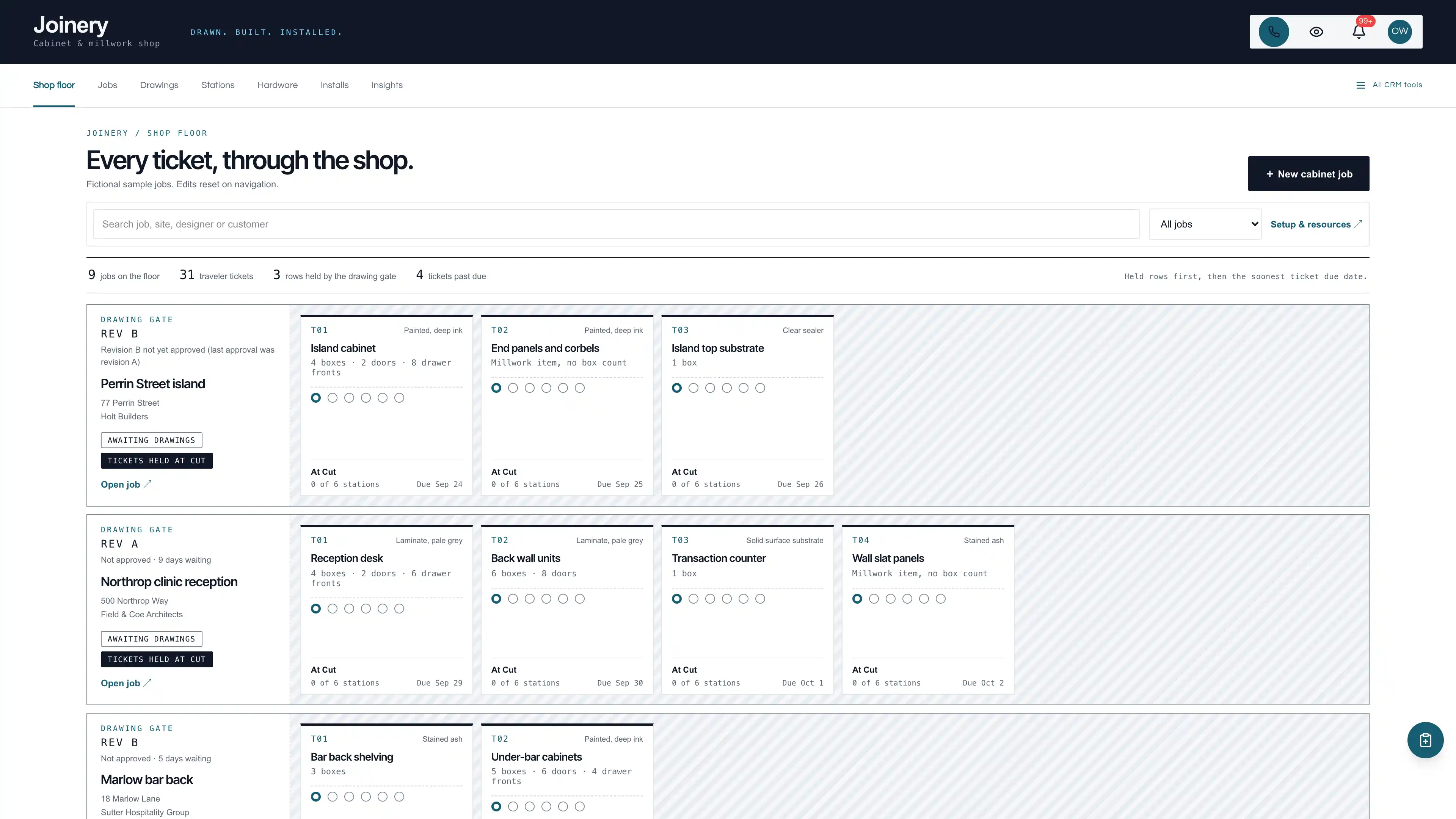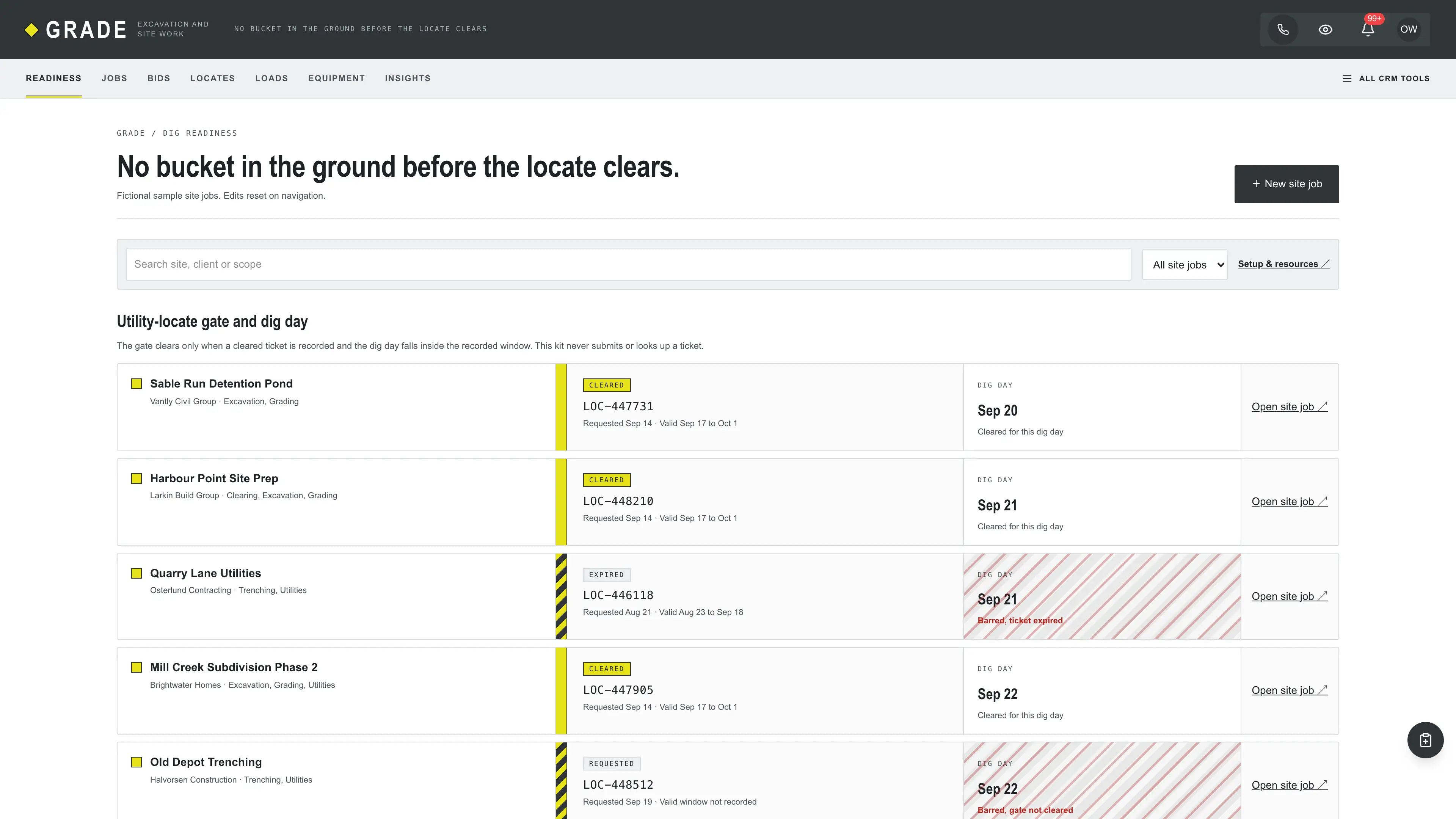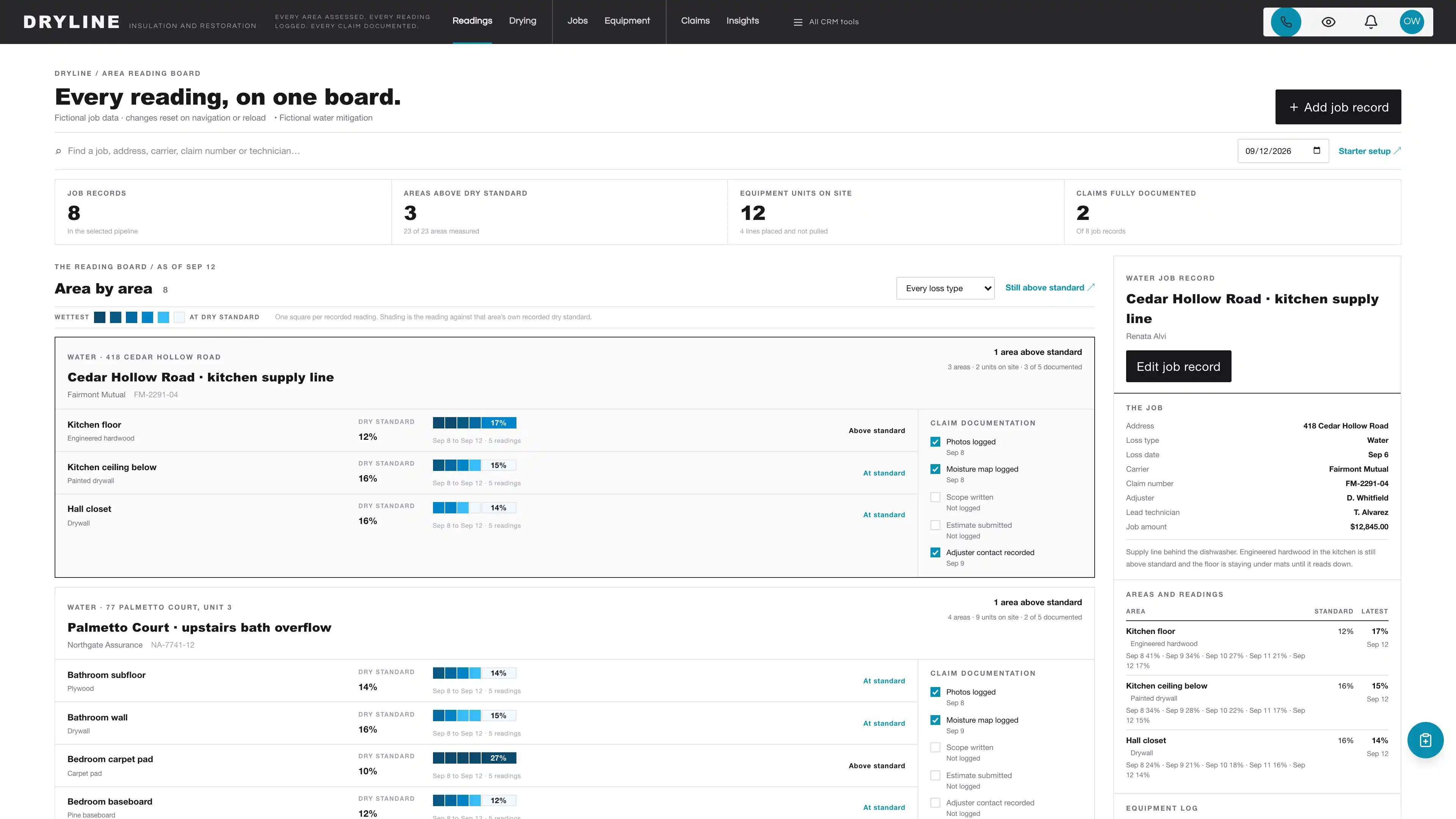
CRM KitsKitchen and bath remodelers
Eight trades. One order.
A kitchen and bath remodel stalls for one of two reasons: a selection nobody made, or a trade that has not finished. Layout puts both on the same row. A pill per selection category above, eight trade chevrons below, and a countdown that names how many decisions are still open before the cabinet order.
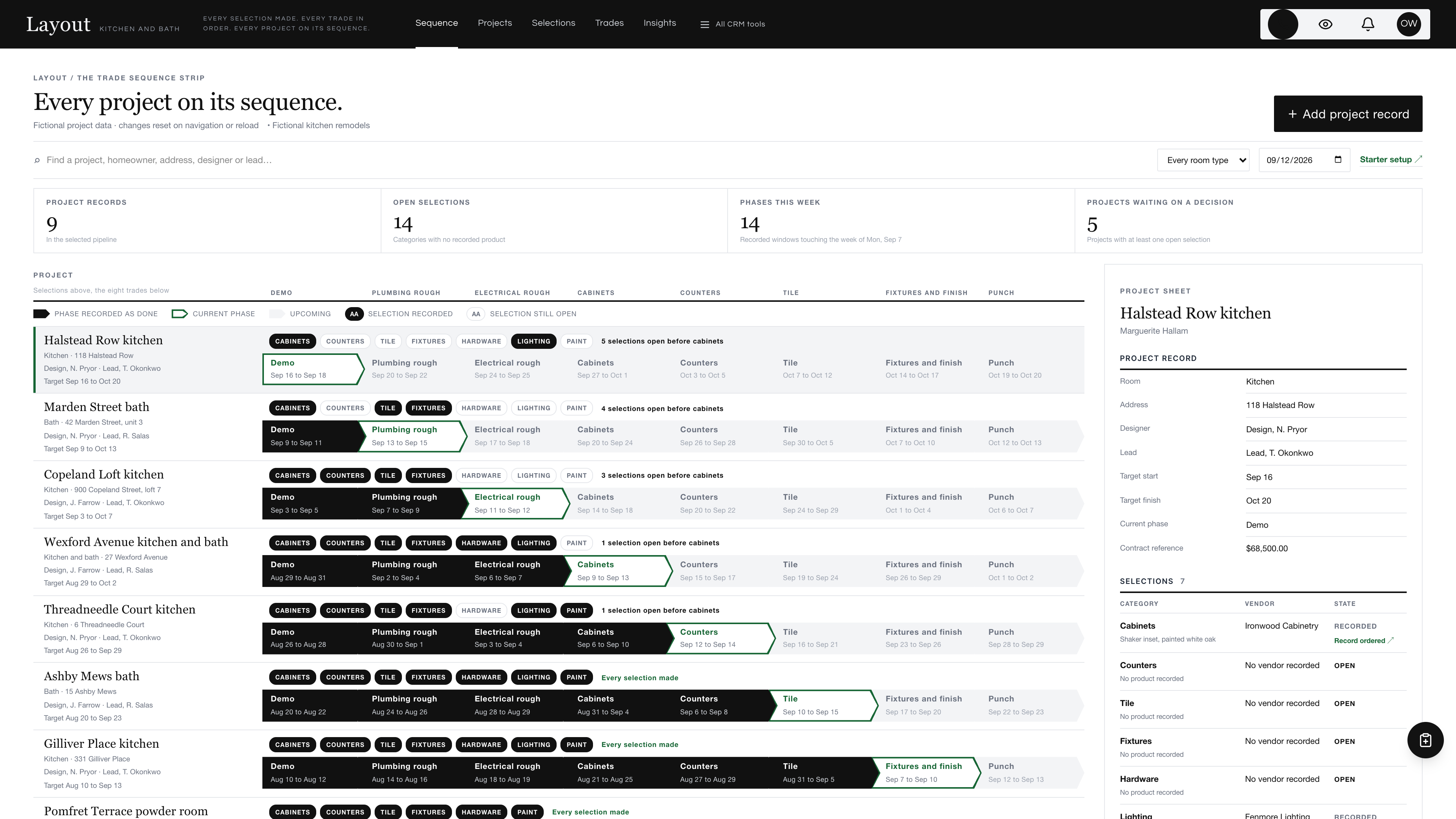
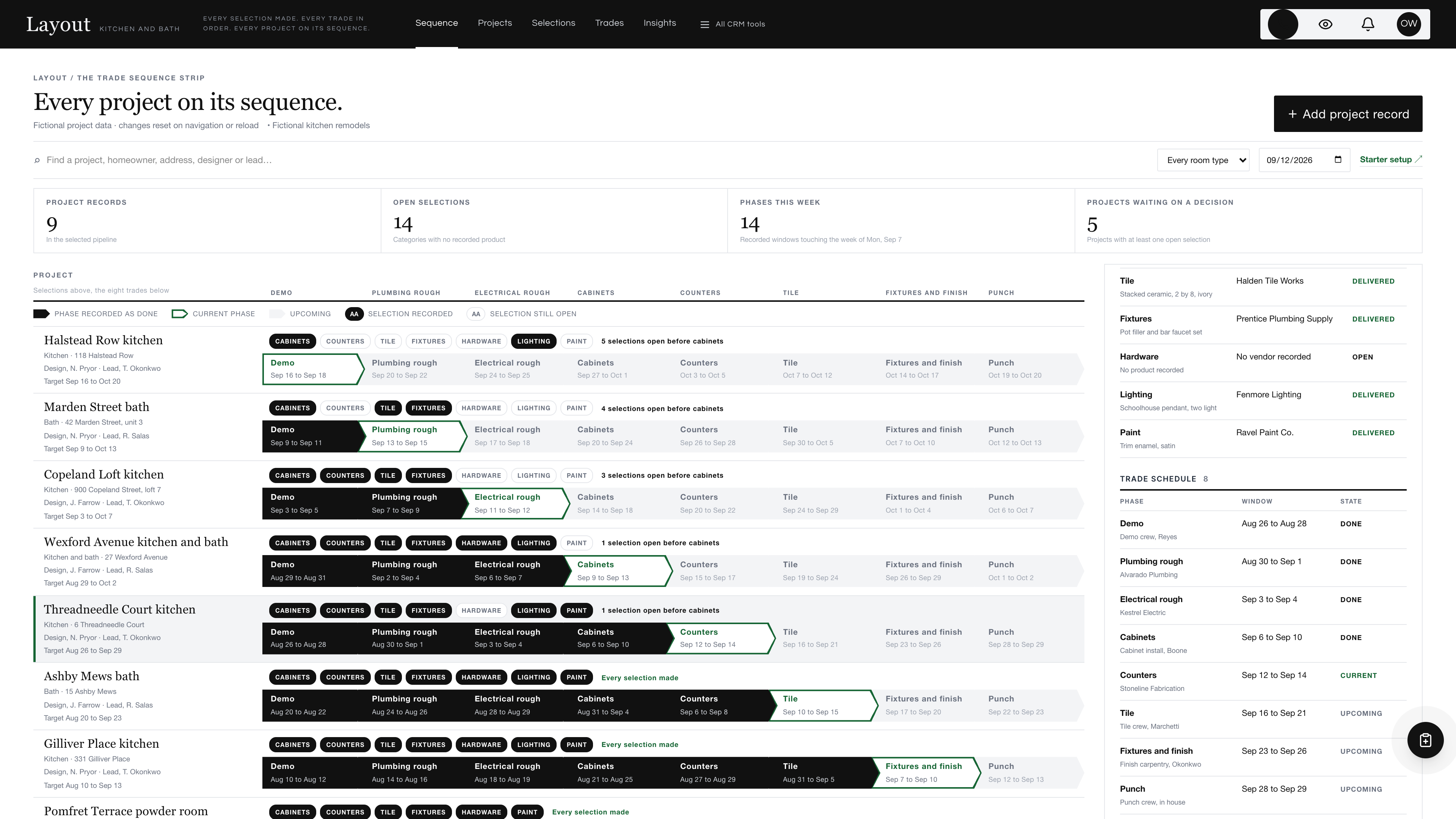
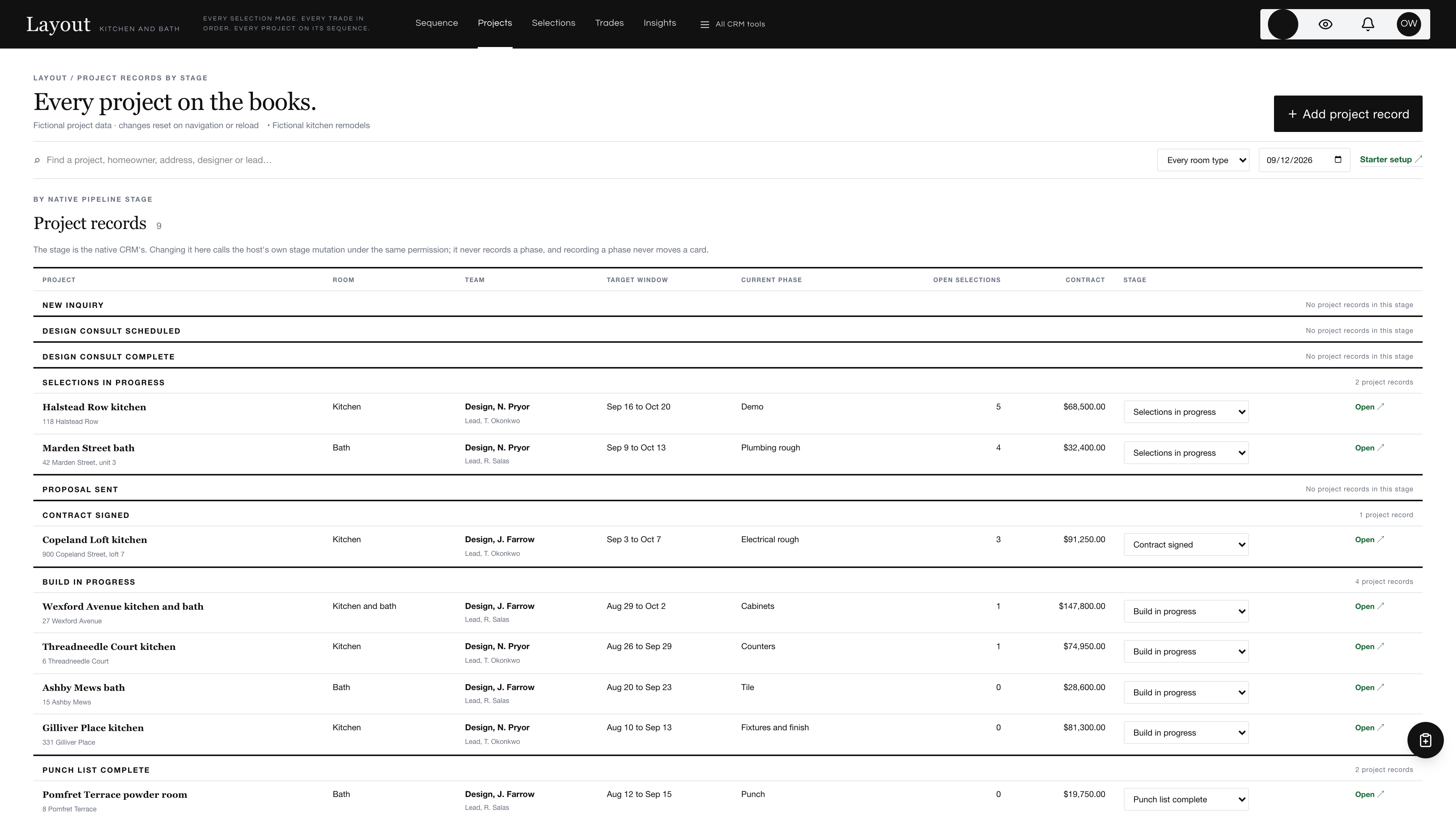
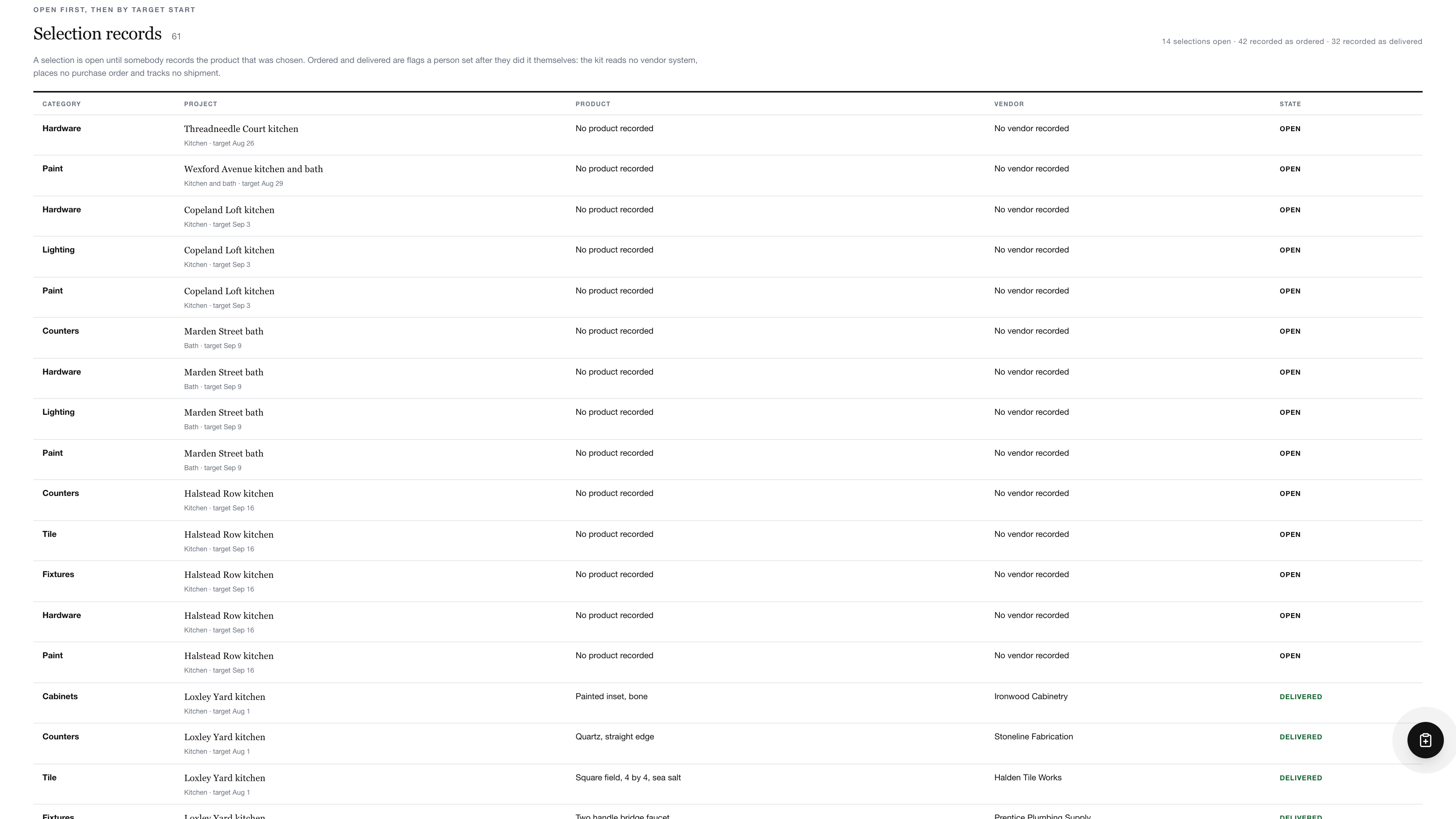
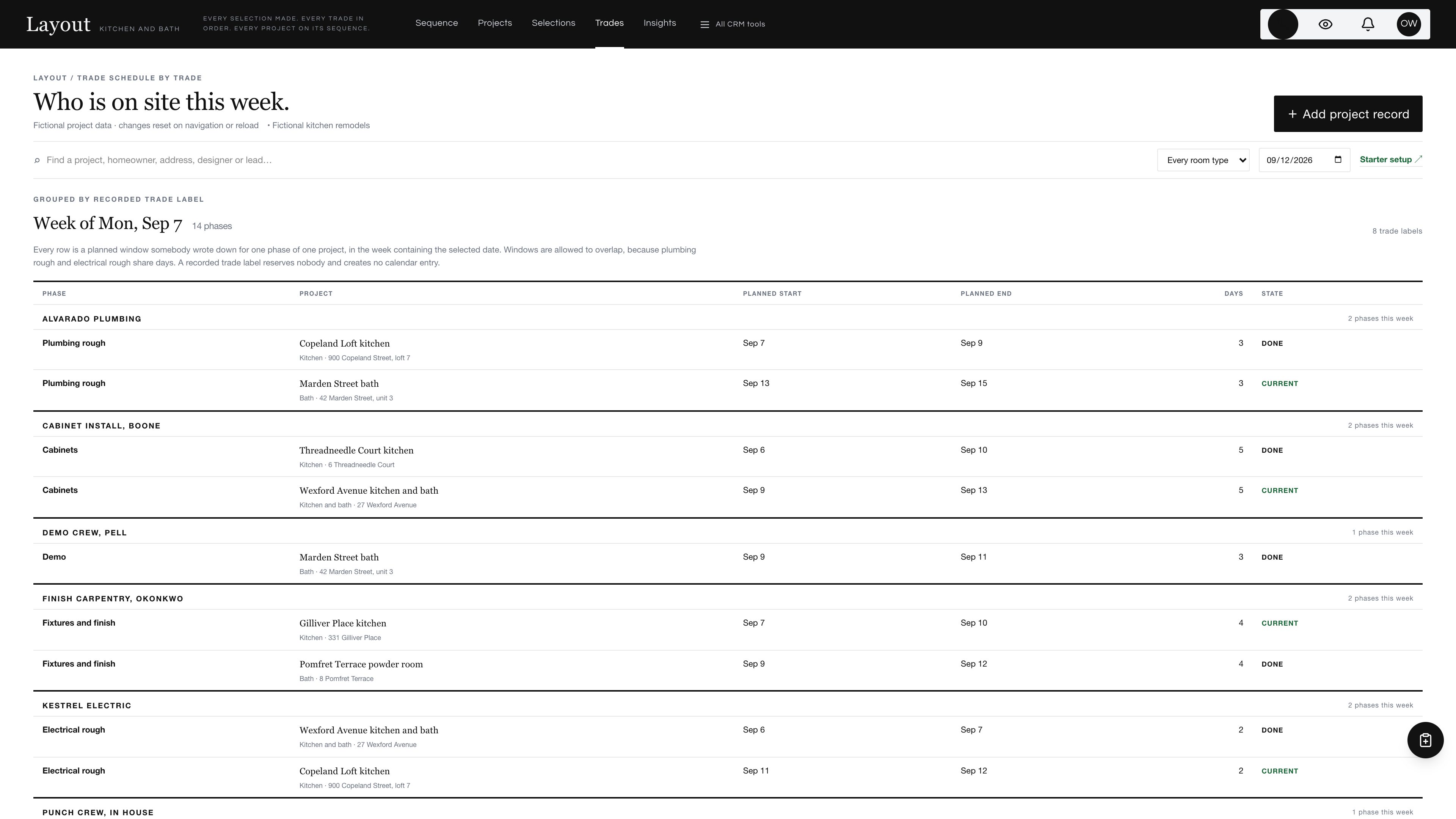
One row per project, two questions answered.
Every project is one band on a white board. Above, a solid pill for each selection category somebody recorded a product for and a hollow pill for each one still open, with a countdown that reads "5 selections open before cabinets" or "Every selection made". Below, eight adjoining chevrons in trade order: filled black for a phase recorded as done, outlined in forest green for the current phase, light gray for what is still ahead. Each chevron carries its recorded window or the words "No window recorded".
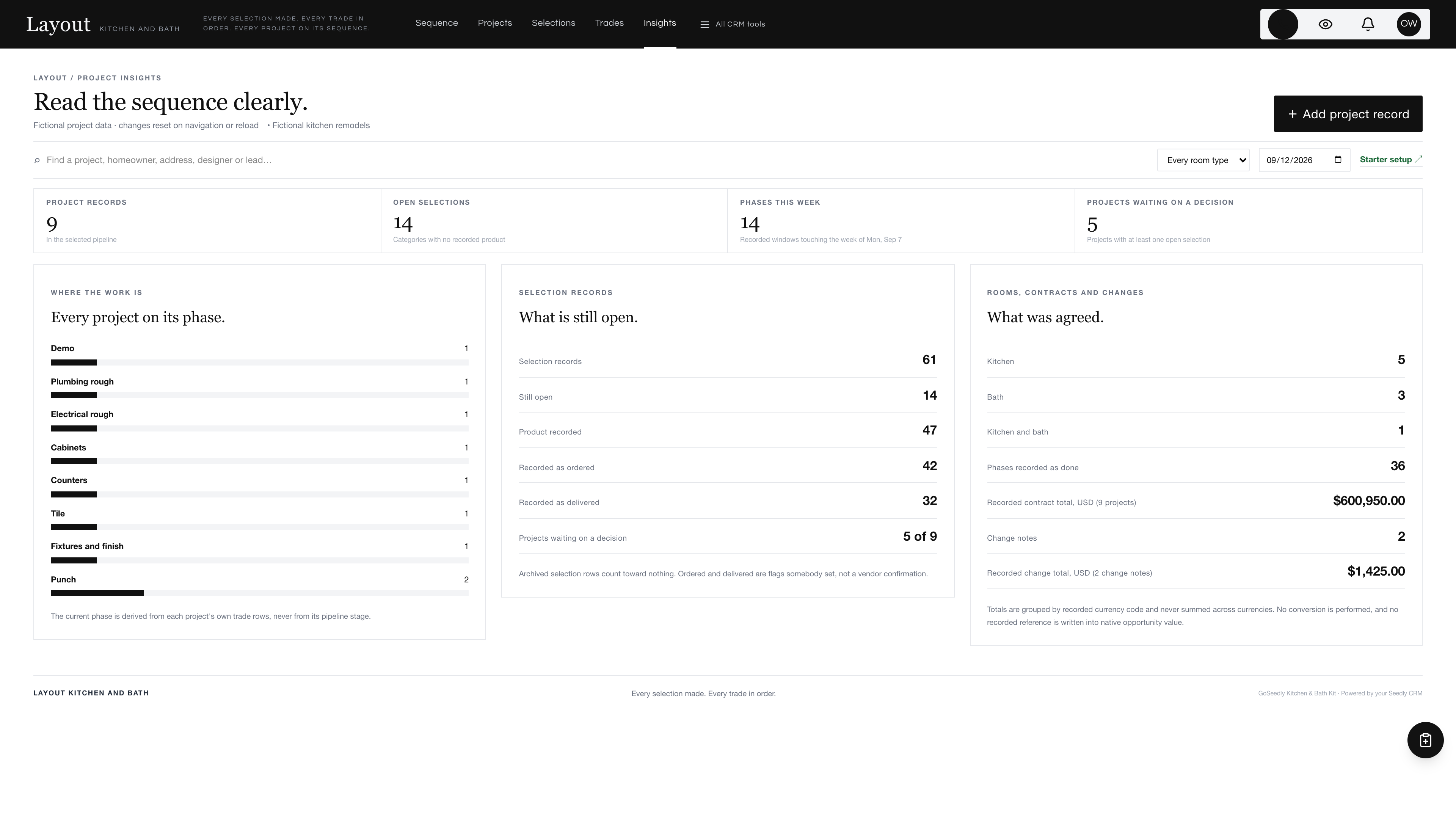
Actual interface captures with fictional sample data. Open a screenshot to see it full size.
What’s in the kit
Screens
- Trade sequence board with eight CSS chevrons and a selections pill row per project
- Project sheet with the selections, the trade schedule, the change notes and the project record
- Project records, selection records and trade schedule views
- Project insights drawn from recorded workspace data only
- Black and forest-green Layout application frame with the permission-filtered CRM tools drawer
four pipelines
- Kitchen remodels · 8 stages
- Bath remodels · 7 stages
- Design and selections consults · 7 stages
- Builder and multifamily packages · 7 stages
Optional. Install the ones that match your work, or connect drafts to a pipeline you already use.
nine workflow drafts
- Design consult review
- Selections deadline reminder
- Selections complete record
- Cabinet order check
- Demo start reminder
- Phase complete record
- Punch list review
- Final walkthrough review
- Thirty day follow-up
Inactive until you review and publish them. None send customer messages.
Sample workspace
Explore nine fictional projects in the separate sample view: kitchens, baths and one whole-floor job, with one project sitting in each of the eight trade phases and one finished project whose whole strip is complete. Sixty-one selections, fourteen of them still open, and two change notes on two of the nine projects, so every chevron state and both pill states appear. Example edits stay in the current page’s memory and reset on navigation or reload; no sample project is ever written to your CRM.
No sample customers are added to your CRM.
Setup and source
- Guided setup and compatibility report
- Private rollback receipt
- AI-agent guide for customized installations
- Original editable source, configuration, and tests
How setup works
Full installation guideCheck your Seedly
Extract the kit and run the guided setup. It checks your installation and flags customized files before it changes anything.
Connect the helper
Deploy the included helper from your backend source, then build your web app and choose any starter pipelines and drafts.
Make it yours
Set company name, descriptor, and default pipeline name. Then sign in and check the workflows and permissions your team uses.
Technical details and compatibility
Seedly CRM 5.8.4 · extension API 1. Node.js 20 or newer. The installer checks supported integration-file versions and does not deploy your web app or backend. The included original kitchen and bath helper is required for connected creation, editing and starter setup. It checks the active account, native permissions and the current record state, re-derives the current phase, preserves unrelated custom fields and unknown values, and invokes the native Seedly mutations inside one transaction. Deploy it from your authoritative backend source before connected edits. Pipeline presets and workflow drafts remain optional, and no schema migration is required.
One project is a native contact-linked opportunity with a namespaced project name, room type, address label, designer and lead labels, target start and finish, a derived current phase, notes, an optional contract reference, and three sets of child records with stable IDs: selections, trade schedule rows and change notes. Two projects at the same address stay independent opportunities, and other custom fields are preserved.
The current phase is the one value the kit computes: the first of the eight trades, in sequence order, that nobody recorded as done, and punch once all eight are. The server re-checks it against the project’s own trade rows, so the chevron strip can never disagree with the schedule table. Everything else is typed in. A planned window and a trade label reserve nobody, create no native Calendar appointment and resolve no conflict, which is why phase windows are allowed to overlap. Ordered and delivered are flags a person set: there is no vendor integration, purchase order, lead time feed or delivery tracking. The contract reference and change note amounts are recorded numbers, kept separate from native opportunity value, with no estimating, allowance engine or price book. A change note amount may be negative, because a change can be a credit. There is no design tool, room planner or rendering, no permit or inspection tracking, no invoicing or signatures, and no client portal or selection approval link. Selections, trade rows and change notes are archived in place, never deleted. Empty values read as words, never a dash.
Four optional pipeline templates and nine inactive workflow drafts. Nine fictional in-memory projects with sixty-one selections and a complete trade sequence.
Calling, messaging, signing, payments, and external integrations depend on your Seedly installation, account permissions, plan, and configured providers. Screenshots use sample data and reference imagery. Hosting, installation, and ongoing maintenance are your responsibility.
Get the Kitchen & Bath Kit
Checking access…

DevLaunch All Access
Every kit and every template.
- All 220 CRM kits for Seedly CRM
- All 270 website templates for Seedly Sites
- Every class, course, and product we release, added as it ships
- Private calls with Aaron
Already a member? Open your downloads.
Questions
How do I receive the kit?
Purchase securely through Whop. Your original source ZIP and installation documentation are delivered manually to the email used at checkout. This is a one-time purchase of this kit; Seedly software, hosting, and installation services are separate.
Does this include Seedly CRM?
You obtain and configure Seedly separately. The kit adds original frontend screens, a shared theme, starter definitions, and integration instructions. It does not include Seedly’s codebase, license, hosting, or a separate CRM database.
Is this one connected workspace?
Layout keeps one black chrome bar across the original kitchen and bath views and the native CRM modules. Full CRM tools remain available within the same signed-in account and application theme. Contacts, Calendar, Estimates, Documents, and other full modules retain the functionality supplied by your own Seedly installation. Existing authored content and provider screens retain their own layouts.
Can I use it with existing customizations?
Yes, with a compatibility review. The installer checks the supported integration files. Changed integration files need a reviewed merge; the included AI-agent guide explains how to preserve custom extensions, permissions, providers, and routes.
Do I have to import all the starter content?
No. Choose individual pipelines and workflow drafts, use a compatible existing pipeline, or install none. Workflows remain inactive until reviewed and published. They use native triggers, internal tasks, optional notes, and timed waits. A wait does not verify task completion or recheck the current stage. The included drafts do not send customer messages.
Can I remove the examples and starter content?
Sample records stay in memory and never create customers in your CRM. Leave sample mode to return to your account. Starter setup lets you review removal of unused kit additions; server checks retain edited or published workflows and pipelines with live work or references. Removing the frontend does not delete account records.
Can different subaccounts use different kits?
The current design and branding apply to the whole web installation. Subaccounts still separate data and access. Use a separate web installation for another full-interface kit; running different kit designs by subaccount in one installation requires additional customization.
More trades & construction kits
Browse all 220 kits