CRM KitsConcrete and masonry contractors
Every pour scheduled. Every cure protected.
Concrete work is not governed by a sales stage. It is governed by a calendar and the weather. A pour day is a truck appointment that cannot move once the mix leaves the plant, the days after it are a cure window nobody may load, an inspector arrives on a day somebody else chose, and rain or a freeze warning pushes all of it. Pour puts one row per job across three weeks of days: a solid black block on the pour day, a gray band after it that lightens one step per cure day, a diamond on every inspection checkpoint, and a hatched band over the days a weather hold covers.
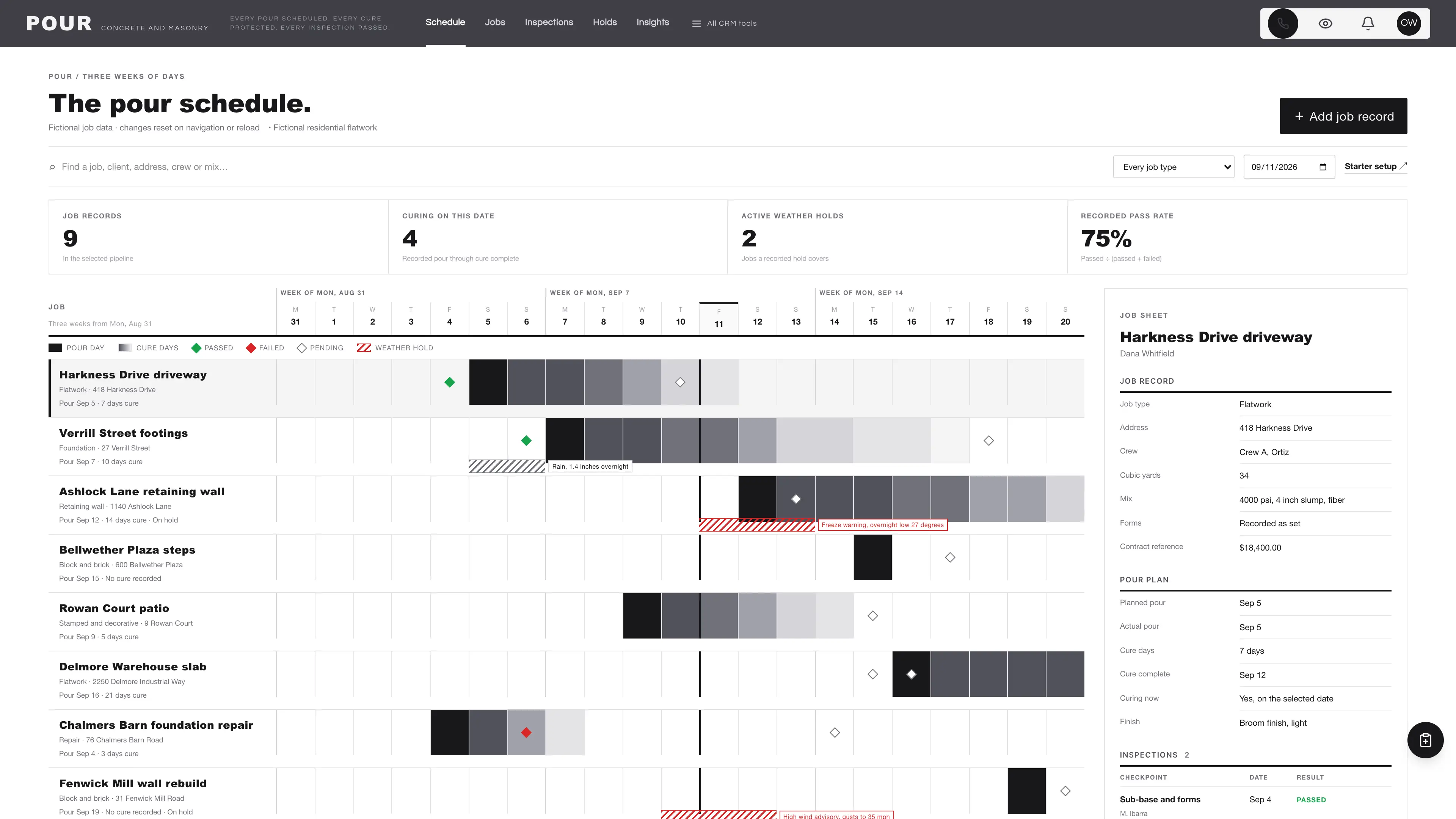
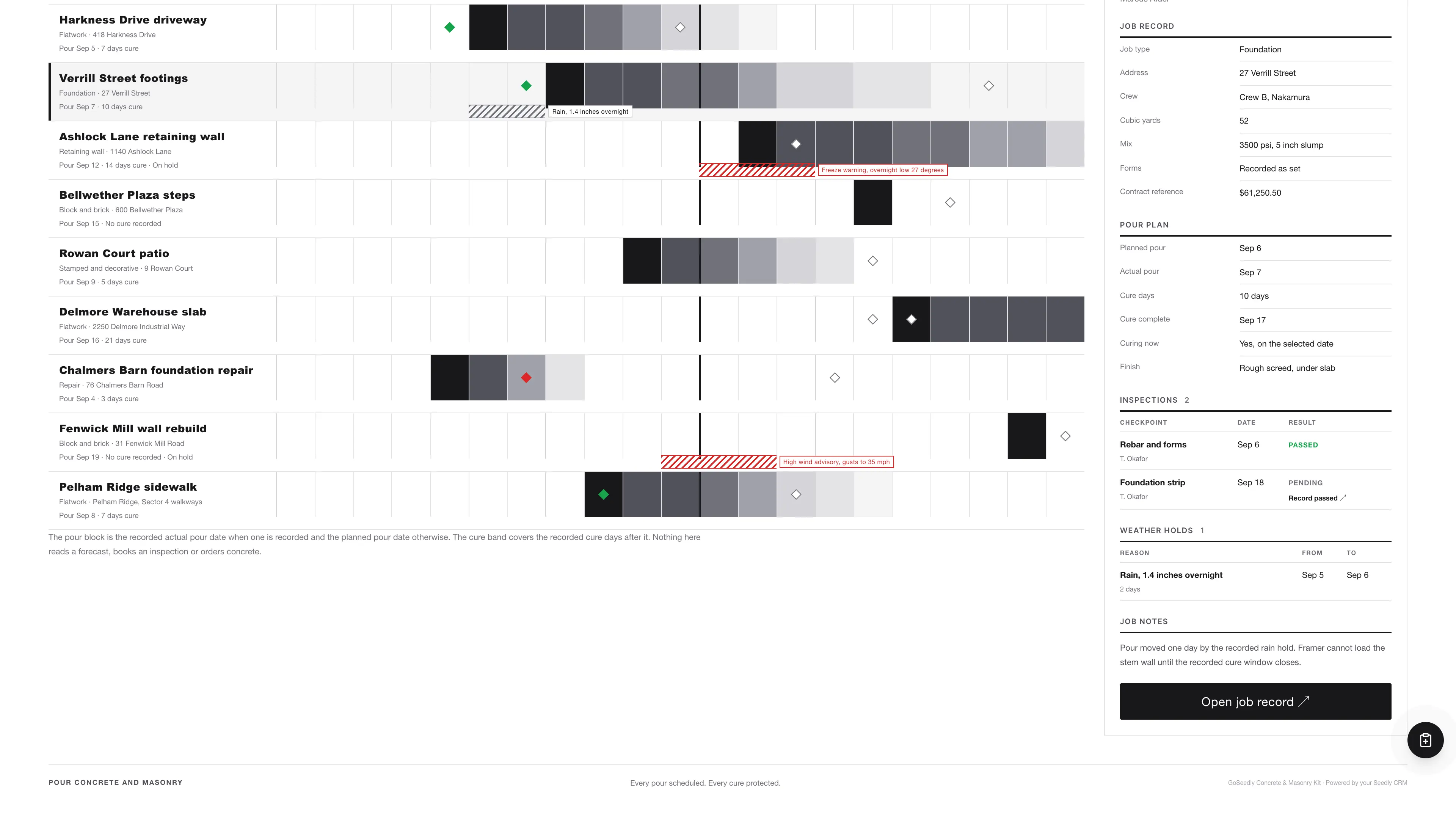
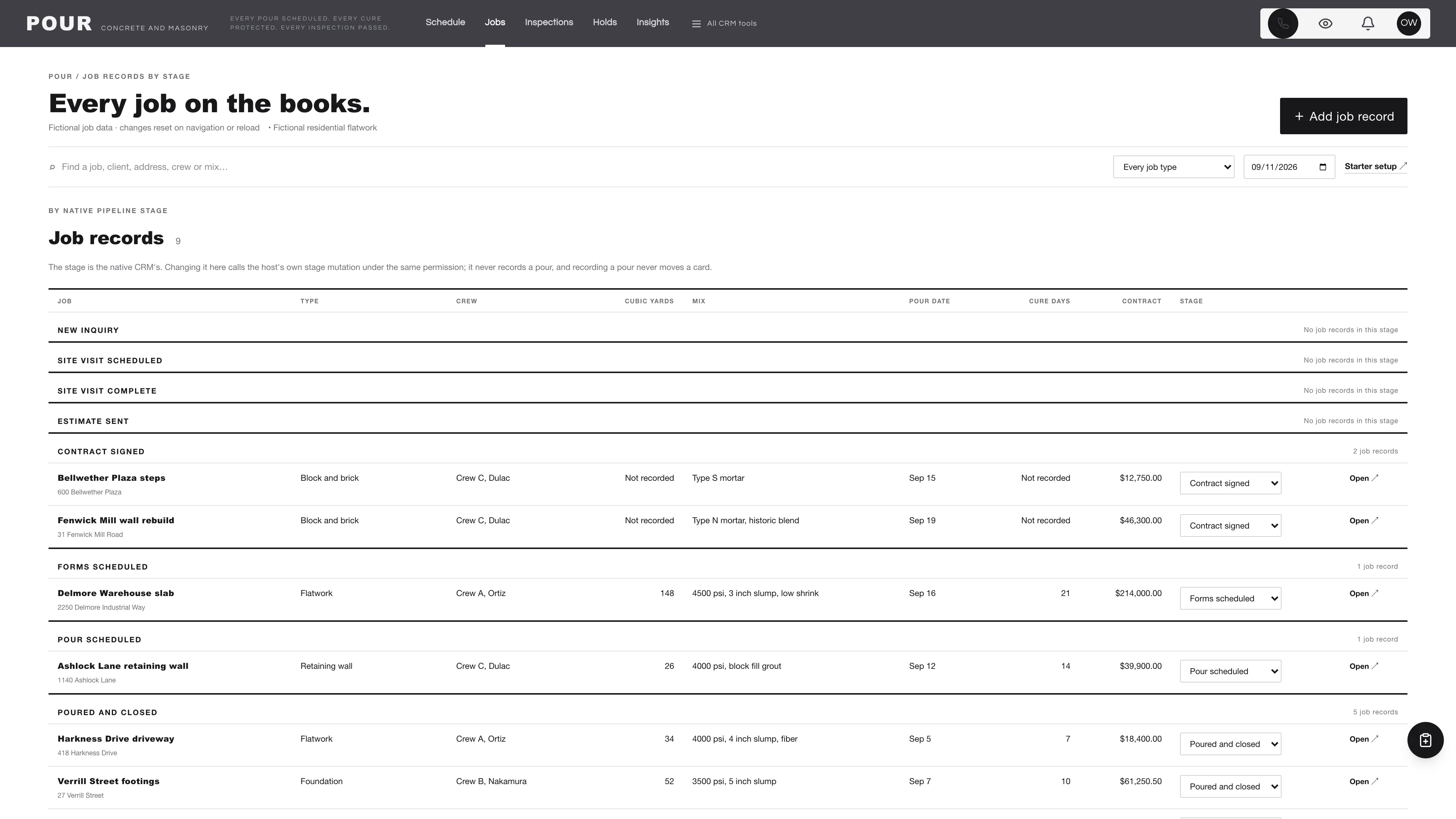
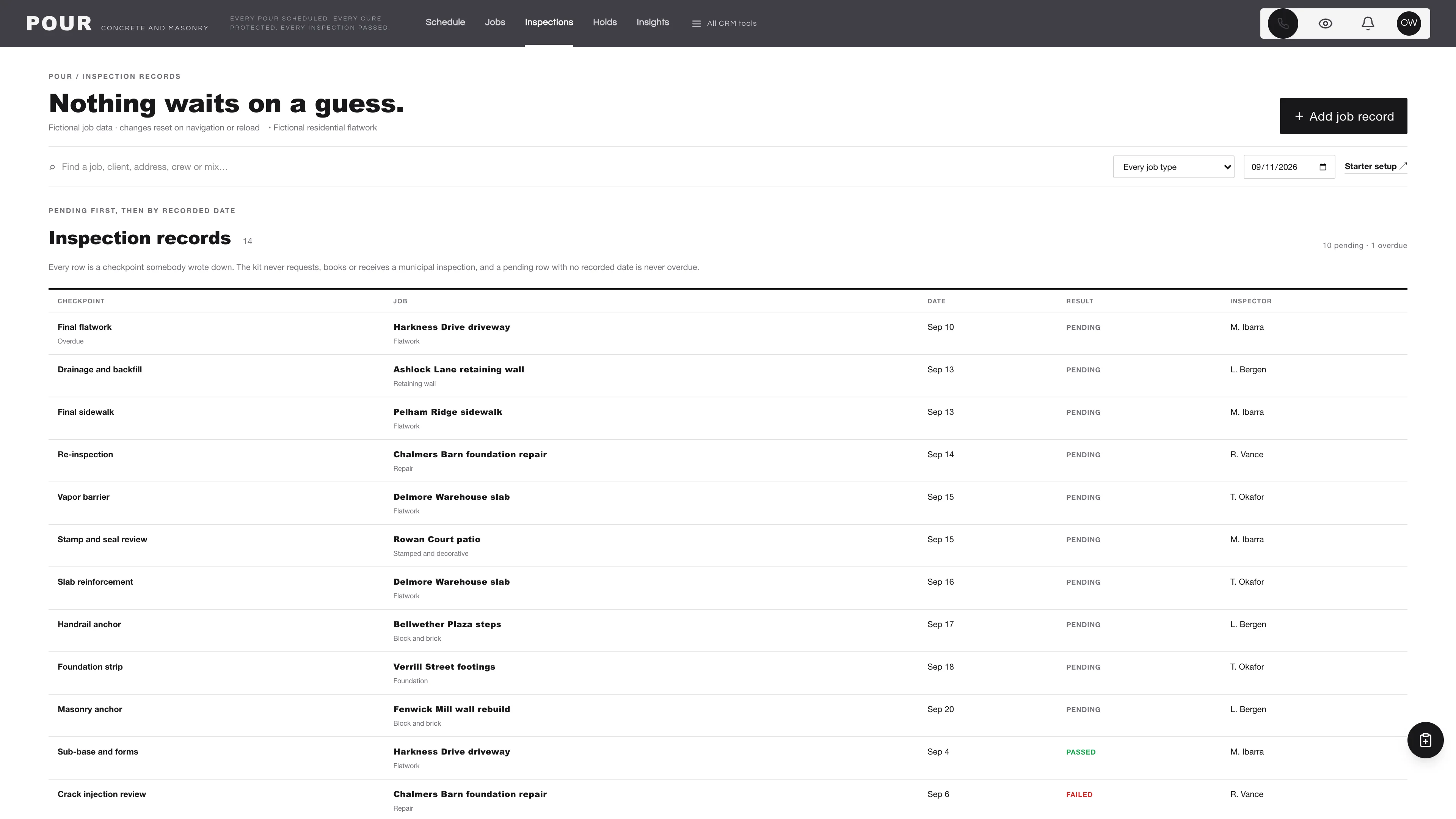
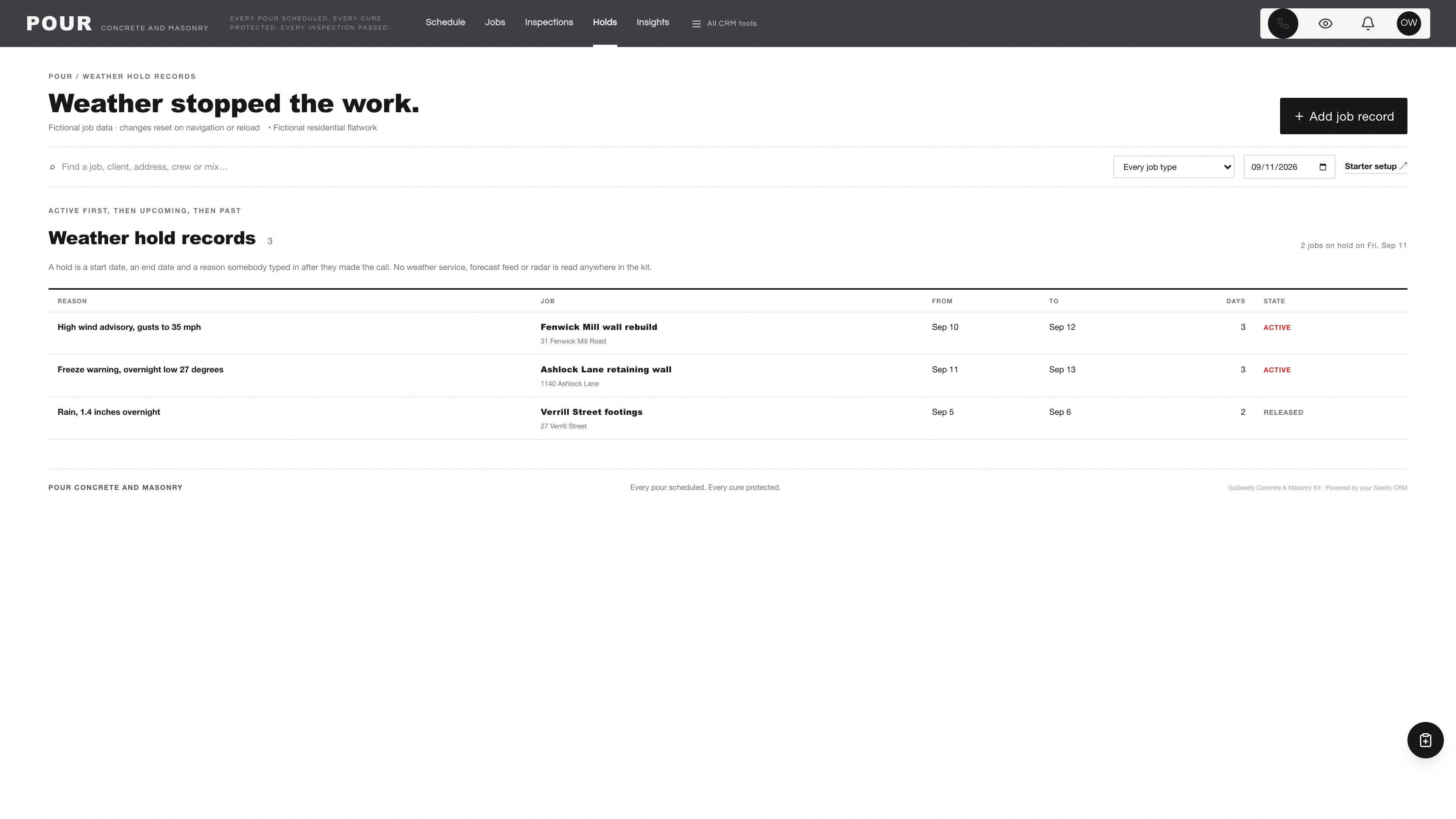
Three weeks of days, one row per job.
A twenty one day ruler grouped into its three weeks, with today marked. Each job draws its pour day as a solid ink block, its recorded cure days as a gray band that lightens toward the end of the window, its inspection checkpoints as diamonds, and each weather hold as a hatched band with its reason printed beside it.
Actual interface captures with fictional sample data. Open a screenshot to see it full size.
What’s in the kit
Screens
- Three-week pour schedule with a solid pour block and a six step cure band that lightens one day at a time
- Inspection checkpoints drawn as green, red and hollow diamonds on their own day, with no image or icon file anywhere in the kit
- Weather holds drawn as hatched bands over the days they cover, red while a hold covers the selected date
- One shared cure rule used by the editor, every view and the server, so a stored cure date can never disagree with its pour date
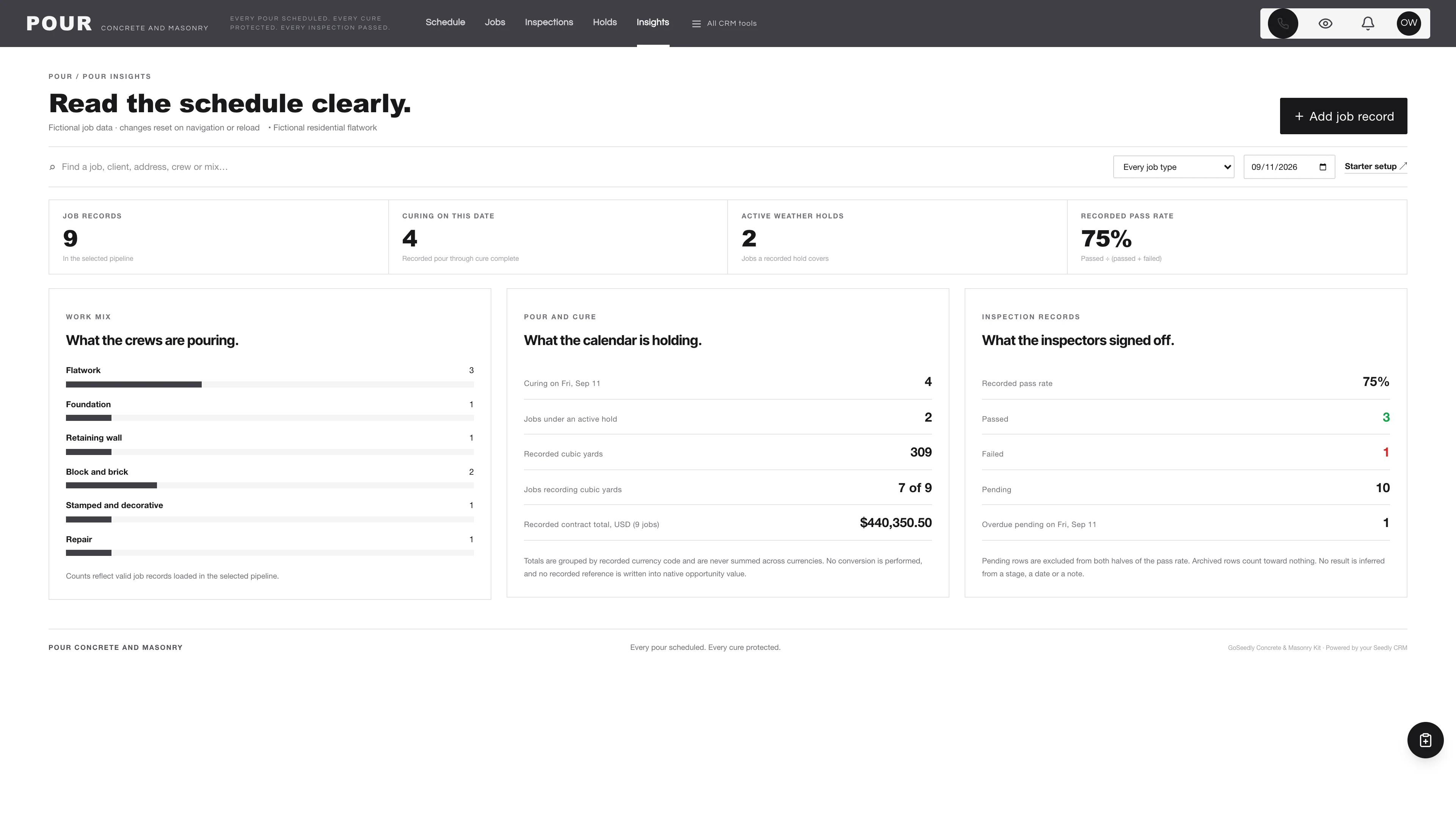
- Jobs by native stage, a cross-job inspection queue with pending first, active weather holds, and insights
- Archive-only inspection and weather hold records with stable IDs, so a checkpoint or a lost day is never erased
- Single dark chrome bar over a white day-axis canvas with full permission-filtered CRM tools
four pipelines
- Residential flatwork · 8 stages
- Foundations and structural · 7 stages
- Masonry and hardscape · 7 stages
- Commercial and municipal bids · 7 stages
Optional. Install the ones that match your work, or connect drafts to a pipeline you already use.
nine workflow drafts
- Site visit review
- Pour day confirmation review
- Pour complete record
- Forms inspection review
- Cure check review
- Final inspection review
- Hold released review
- Warranty walkthrough review
- Weather hold record
Inactive until you review and publish them. None send customer messages.
Sample workspace
Explore nine fictional jobs across the three weeks and all six job types, from a residential driveway to a 148 yard warehouse slab, with 14 inspection records and three weather holds. Two of those holds cover today so the active hatching is visible, one inspection is recorded as failed and three as passed so all three diamond states appear, and seven of the nine rows record cure days so the lightening band reads across the board. Example edits stay in the current page’s memory and reset on navigation or reload; sample jobs are never inserted into your CRM.
No sample customers are added to your CRM.
Setup and source
- Guided setup and compatibility report
- Private rollback receipt
- AI-agent guide for customized installations
- Original editable source, configuration, and tests
How setup works
Full installation guideCheck your Seedly
Extract the kit and run the guided setup. It checks your installation and flags customized files before it changes anything.
Connect the helper
Deploy the included helper from your backend source, then build your web app and choose any starter pipelines and drafts.
Make it yours
Set company name, descriptor, promise line, and default pipeline name. Then sign in and check the workflows and permissions your team uses.
Technical details and compatibility
Seedly CRM 5.8.4 · extension API 1. Node.js 20 or newer. The installer checks supported integration-file versions and does not deploy your web app or backend. The included original pour helper is required for connected creation, editing and starter setup. It preserves native account permissions and unrelated custom fields, re-checks the cure arithmetic along with the forms, crew, inspection date and weather hold rules, and compares the current record state before saving. It exposes no stage mutation at all, so pipeline stages stay in your CRM’s own views under your existing roles. Deploy the helper from your authoritative backend source before connected edits. Pipeline presets and workflow drafts remain optional.
A job is a native contact-linked opportunity with a namespaced job type, site address label, crew label, cubic yards reference, mix label, a forms set flag, planned and actual pour dates, recorded cure days, a derived cure complete date, finish label, job notes, an immutable supported currency, inspection records with their result and inspector label, and weather hold records with their dates and reason. The recorded contract reference stays separate from native opportunity value. Other custom fields are preserved.
Every date is one somebody wrote down, and the one derived value is arithmetic on two of them. The recorded pour date is the actual pour when one is recorded and the planned pour otherwise, because the cure starts when the concrete goes down. The cure complete date must equal that date advanced by the recorded cure days and must be blank when either is missing; the editor recomputes it on every edit and the server refuses a stored value that disagrees, so the board can never contradict the sheet. Cure days are calendar days from a specification or a superintendent, never a strength calculation, maturity index or cylinder break. Because nobody pours into ground with no forms around it, a recorded actual pour requires forms recorded as set, and cure days or a crew label require a recorded pour date. A passed or failed inspection requires a recorded date while a pending one may leave it blank, and an inspection date is deliberately not constrained against the pour, because forms inspections happen before it and final inspections after it. A weather hold needs both dates in order plus a reason, and two holds on one job may overlap because rain on Monday and a freeze warning on Tuesday are separate facts. The pass rate excludes pending rows from both halves and reports None recorded rather than an invented zero. There is no weather data, forecast feed or radar, no permit system or municipal inspection scheduling, no ready-mix ordering or delivery ticket, no estimating or takeoff, no crew scheduling engine or dispatch, and no invoicing or payments. Nothing here contacts a client, an inspector or a supplier. Totals are grouped by currency and never added across currencies. The pipeline stage stays your CRM’s own: recording a pour never moves a card, and moving a card never records a pour.
Four optional pipeline templates and nine inactive workflow drafts. Nine fictional in-memory jobs with 14 inspection records and three weather holds across three weeks.
Calling, messaging, signing, payments, and external integrations depend on your Seedly installation, account permissions, plan, and configured providers. Screenshots use sample data and reference imagery. Hosting, installation, and ongoing maintenance are your responsibility.
Get the Concrete & Masonry Kit
Checking access…

DevLaunch All Access
Every kit and every template.
- All 220 CRM kits for Seedly CRM
- All 270 website templates for Seedly Sites
- Every class, course, and product we release, added as it ships
- Private calls with Aaron
Already a member? Open your downloads.
Questions
How do I receive the kit?
Purchase securely through Whop. Your original source ZIP and installation documentation are delivered manually to the email used at checkout. This is a one-time purchase of this kit; Seedly software, hosting, and installation services are separate.
Does this include Seedly CRM?
You obtain and configure Seedly separately. The kit adds original frontend screens, a shared theme, starter definitions, and integration instructions. It does not include Seedly’s codebase, license, hosting, or a separate CRM database.
Is this one connected workspace?
Pour keeps its concrete and masonry navigation in one chrome bar across the original schedule views and native CRM modules. Full CRM tools remain available within the same signed-in account and application theme. Contacts, Calendar, Estimates, Documents, and other full modules retain the functionality supplied by your own Seedly installation. Existing authored content and provider screens retain their own layouts.
Can I use it with existing customizations?
Yes, with a compatibility review. The installer checks the supported integration files. Changed integration files need a reviewed merge; the included AI-agent guide explains how to preserve custom extensions, permissions, providers, and routes.
Do I have to import all the starter content?
No. Choose individual pipelines and workflow drafts, use a compatible existing pipeline, or install none. Workflows remain inactive until reviewed and published. They use native triggers, internal tasks, optional notes, and timed waits. A wait does not verify task completion or recheck the current stage. The included drafts do not send customer messages.
Can I remove the examples and starter content?
Sample records stay in memory and never create customers in your CRM. Leave sample mode to return to your account. Starter setup lets you review removal of unused kit additions; server checks retain edited or published workflows and pipelines with live work or references. Removing the frontend does not delete account records.
Can different subaccounts use different kits?
The current design and branding apply to the whole web installation. Subaccounts still separate data and access. Use a separate web installation for another full-interface kit; running different kit designs by subaccount in one installation requires additional customization.
More trades & construction kits
Browse all 220 kits